Research Innovation Toward Precision Home Visiting
The Home Visiting Applied Research Collaborative (HARC) is a national research and development platform for innovation to broaden and strengthen home visiting's benefits for all families and communities.
Featured Items from HARC
-
Fall Webinar Series
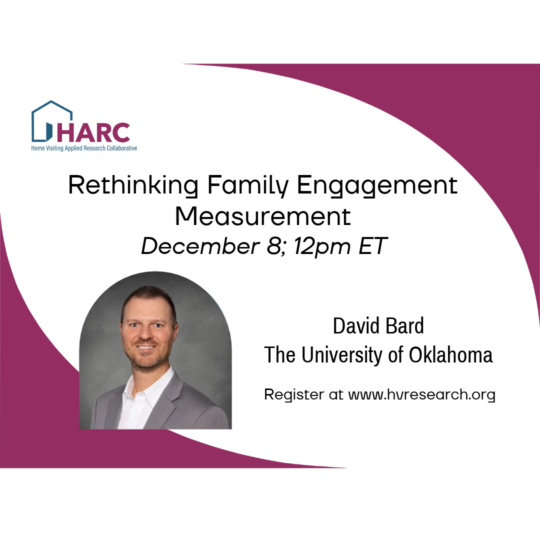
Rethinking Family Engagement Measurement: From Visit Counts and Self-Reports to Routine Documentation and AI. December 8, at 12pm ET
Family engagement is central to home visiting effectiveness, yet commonly used measures tell us relatively little about how families actively participate during and between visits. Drawing on Oklahoma’s MIECHV Coordinated State Evaluation, David Bard will trace efforts to define active family involvement, identify indicators of engagement in routine program documentation and participant-reported measures, and test whether computational methods can extract and use these signals at scale. Findings from multiple approaches will illustrate the opportunities and challenges of combining routinely collected program data with purpose-built measures to develop more meaningful assessments of family engagement.
Register Here -

Find an Expert Initiative
Request Research Assistance from HARC Experts
Do you need advice on a research topic, question, or method? Use HARC's Find an Expert initiative to get connected with a HARC researcher or evaluator with the expertise that you need.
Find out more and learn how to request assistance. -
Join a HARC SIG
Make connections and keep learning with a HARC SIG. Meet with colleagues in a smaller group, discuss topics that matter to you, share ideas, explore the latest research, and discover new professional development opportunities. Join a HARC Special Interest Group (SIG) and get involved!
Click here for more information
The Precision Paradigm
To strengthen family engagement and home visiting’s benefits for families, we need a different approach to research. We need to focus on interventions within and across home visiting models. We need to answer the question: What works best, for which families, in which contexts, why, and how?

The Latest HARC Resources
View All Resources-
-

Research Brief
Precision Home Visiting: Behavior-Focused Techniques
This brief introduces HARC’s taxonomy of 81 behavior-focused intervention techniques to support precision home visiting research. Intervention techniques are the intentional, observable, replicable actions home…
-

Resource to Identify Relational Communication Techniques in Home Visiting Techniques are intentional, observable actions by a home visitor to support a family. HARC recently released…
Get Connected
Join our Practice-Based Research Network!
Interested in Conducting Collaborative Studies with Local Home Visiting Programs

Browse Home Visiting Research, Toolkits and Literature Updates
Search the HARC Resource Library - research briefs, peer-reviewed publications, data collection tools, presentations, toolkits and more!
Learn more about: Research and Toolkits-
Home Visiting Peer Reviewed Literature Updates
Each month, HARC collates recently published peer-reviewed home visiting research articles. Articles are identified via a Google Scholar alert, thus the list may not include…
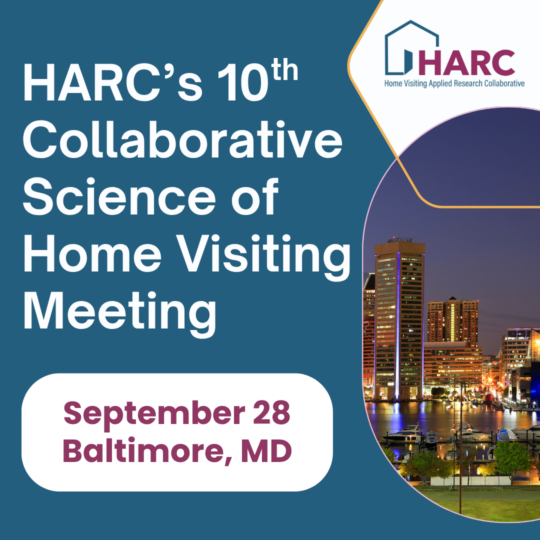
HARC's 10th Collaborative Science of Home Visiting Meeting
Home visiting research can only make an impact if it reaches practice — and that was the focus of HARC’s Collaborative Science of Home Visiting meeting held on September 28.
Featured presentations from Fred Wulczyn, Kimberly Becker, Jay Buzhardt, Laurel Davis, Ronda Jensen, Nicole Lauzus, and Alex Morshed highlighted practical approaches to translation and actionable evidence use, including a framework to promote research evidence in practice, decision-support tools, utilization of HARC’s practice-based research network, and data sharing and data linking projects.
A big thank-you to the incredible presenters who helped spark thoughtful conversations about how evidence can inform and strengthen practice in home visiting. Events like this remind us how much is possible when research and practice come together. HARC is excited to keep the conversation going.