HARC Webinars
Highlighting Innovative Methods and Emerging Issues in Home Visiting Research to Practice
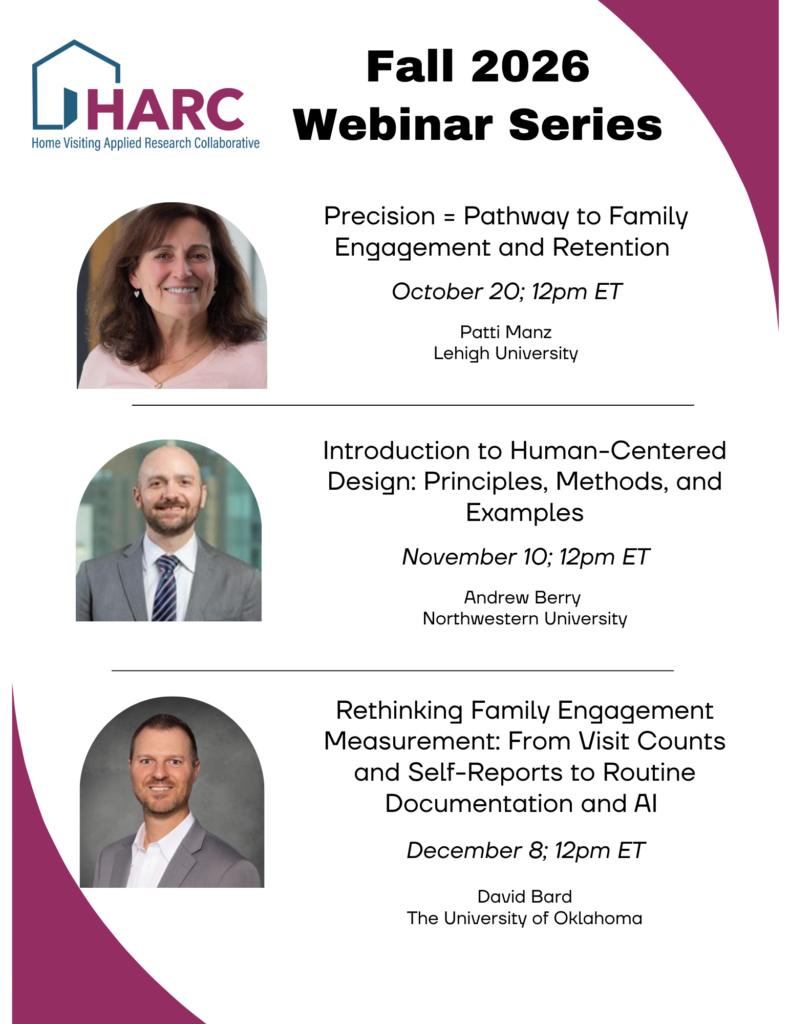
Precision = Pathway to Family Engagement and Retention
Patti Manz, Lehigh University
October 20 at 12pm ET
Home visiting that supports families’ goals for their children’s well-being engages and retains families. In this webinar, the Little Talks program will be presented as an illustration of individualized implementation of evidence-based child-focused communication and language practices in home visiting. Little Talks has been designed and evaluated in partnership with home visiting professionals and families. As a comprehensive professional development and parenting intervention, Little Talks has proven to improve the quality of home visiting services and benefit parents and young children, which are necessary for engagement and retention. Webinar attendees will learn about home visitors’ strategies to individualize Little Talks as well as the professional coaching support that they received. Attendees will have the opportunity to consider application of these processes to their home visiting programs.
Introduction to Human-Centered Design: Principles, Methods, and Examples
Andrew Berry, Northwestern University
November 10 at 12pm ET
This webinar will describe human-centered design (HCD) principles and methods, including why it is valuable and how it can be done. Using examples from the presenter’s research, attendees will develop understanding of phases of the HCD process and useful methods for each phase.
Rethinking Family Engagement Measurement: From Visit Counts and Self-Reports to Routine Documentation and AI
David Bard, The University of Oklahoma
December 8 at 12pm ET
Family engagement is central to home visiting effectiveness, yet commonly used measures such as visit counts and retention tell us relatively little about how families actively participate during and between visits. Drawing on Oklahoma’s MIECHV Coordinated State Evaluation, this webinar will trace efforts to define active family involvement, identify indicators of engagement in routine program documentation and participant-reported measures, and test whether computational methods can extract and use these signals at scale. Findings from qualitative research, human coding, survey-based measurement, and emerging machine-learning and language-model approaches will illustrate both the opportunities and challenges of combining routinely collected program data with purpose-built measures to develop richer and more meaningful assessments of family engagement.